Padding policy that pads the last dimension for SIMD alignment. More...
#include <simd_padding_policy.h>
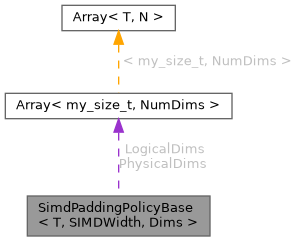
Static Public Member Functions | |
| static constexpr Array< my_size_t, NumDims > | computeLogicalDims () |
| static constexpr my_size_t | pad (my_size_t n) |
| static constexpr my_size_t | computePhysicalSize () |
| static constexpr Array< my_size_t, NumDims > | computePhysicalDims () |
Static Public Attributes | |
| static constexpr my_size_t | SimdWidth = SIMDWidth |
| static constexpr my_size_t | NumDims = sizeof...(Dims) |
| static constexpr Array< my_size_t, NumDims > | LogicalDims = computeLogicalDims() |
| static constexpr my_size_t | LastDim = LogicalDims[NumDims - 1] |
| static constexpr my_size_t | PaddedLastDim = pad(LastDim) |
| static constexpr my_size_t | LogicalSize = (Dims * ...) |
| static constexpr my_size_t | PhysicalSize = computePhysicalSize() |
| static constexpr Array< my_size_t, NumDims > | PhysicalDims = computePhysicalDims() |
Detailed Description
struct SimdPaddingPolicyBase< T, SIMDWidth, Dims >
Padding policy that pads the last dimension for SIMD alignment.
- Template Parameters
-
T Element type (float, double, Complex<float>, etc.) Dims Logical dimensions of the tensor (e.g., 8, 6 for an 8x6 matrix)
All computations happen at compile-time. No runtime overhead.
THE PROBLEM THIS SOLVES
SIMD load instructions (e.g., _mm256_load_pd) require memory addresses to be aligned to SimdWidth * sizeof(T) bytes. For AVX with double:
- SimdWidth = 4 (four doubles per register)
- Required alignment = 4 * 8 = 32 bytes
For a tensor A[8, 6] stored in row-major order WITHOUT padding:
Memory layout (each cell = 1 double = 8 bytes):
Index: 0 1 2 3 4 5 | 6 7 8 9 10 11 | 12 13 14 15 16 17 | ... Row: |-— row 0 -—| |-— row 1 --—| |-— row 2 ---—| ... Address: 0 8 16 24 32 40 48 56 64 72 80 88 96 ... ^ Row 1 starts at byte 48 48 % 32 = 16 ≠ 0 → NOT ALIGNED!
Strides: [6, 1] Row bases: 0, 6, 12, 18, 24, 30, 36, 42
Alignment check (need base % SimdWidth == 0): Row 0: base=0, 0 % 4 = 0 ✓ Row 1: base=6, 6 % 4 = 2 ✗ MISALIGNED → SEGFAULT! Row 2: base=12, 12 % 4 = 0 ✓ Row 3: base=18, 18 % 4 = 2 ✗ MISALIGNED → SEGFAULT!
THE SOLUTION: PAD THE LAST DIMENSION
Pad the last dimension to the next multiple of SimdWidth.
For A[8, 6] with SimdWidth=4:
- Logical last dim: 6
- Padded last dim: 8 (next multiple of 4)
- Physical storage: 8 rows × 8 cols = 64 elements
Memory layout WITH padding:
Index: 0 1 2 3 4 5 P P | 8 9 10 11 12 13 P P | 16 17 ... Row: |-— row 0 -—| pad | |-— row 1 --—| pad | ... Address: 0 8 16 24 32 40 48 56 64 72 80 88 96 104 ... ^ Row 1 starts at byte 64 64 % 32 = 0 → ALIGNED!
P = padding slots (allocated but unused, zero-initialized)
Strides: [8, 1] ← computed from PADDED dimensions! Row bases: 0, 8, 16, 24, 32, 40, 48, 56
Alignment check: Row 0: base=0, 0 % 4 = 0 ✓ Row 1: base=8, 8 % 4 = 0 ✓ Row 2: base=16, 16 % 4 = 0 ✓ Row 3: base=24, 24 % 4 = 0 ✓ ... ALL ALIGNED!
EXAMPLES FOR DIFFERENT TYPES AND DIMENSIONS
Example 1: FusedTensorND<double, 8, 6> (AVX, SimdWidth=4)
- Logical dims: [8, 6]
- Padded last dim: pad(6) = 8 (next multiple of 4)
- Physical size: 8 * 8 = 64 elements
- Memory overhead: 64 vs 48 = 33%
Example 2: FusedTensorND<float, 8, 6> (AVX, SimdWidth=8)
- Logical dims: [8, 6]
- Padded last dim: pad(6) = 8 (next multiple of 8)
- Physical size: 8 * 8 = 64 elements
- Memory overhead: 64 vs 48 = 33%
Example 3: FusedTensorND<float, 5, 10> (AVX, SimdWidth=8)
- Logical dims: [5, 10]
- Padded last dim: pad(10) = 16 (next multiple of 8)
- Physical size: 5 * 16 = 80 elements
- Memory overhead: 80 vs 50 = 60%
Example 4: FusedTensorND<double, 4, 4> (AVX, SimdWidth=4, already aligned)
- Logical dims: [4, 4]
- Padded last dim: pad(4) = 4 (already multiple of 4, no change)
- Physical size: 4 * 4 = 16 elements
- Memory overhead: 0%
Example 5: FusedTensorND<float, 2, 3, 5> (AVX, SimdWidth=8, 3D tensor)
- Logical dims: [2, 3, 5]
- Only LAST dimension is padded: pad(5) = 8
- Physical dims: [2, 3, 8]
- Physical size: 2 * 3 * 8 = 48 elements
- Strides: [24, 8, 1] (computed from physical dims)
Example 6: FusedTensorND<Complex<double>, 8, 6> (AVX, SimdWidth=2)
- sizeof(Complex<double>) = 16 bytes
- SimdWidth = 2 (from Microkernel<Complex<double>, 256, X86_AVX>)
- Logical dims: [8, 6]
- Padded last dim: pad(6) = 6 (already multiple of 2)
- Physical size: 8 * 6 = 48 elements
- Memory overhead: 0%
Example 7: FusedTensorND<double, 8, 6> (GENERICARCH, SimdWidth=1)
- Logical dims: [8, 6]
- Padded last dim: pad(6) = 6 (everything is multiple of 1)
- Physical size: 8 * 6 = 48 elements
- Memory overhead: 0% (no padding when no SIMD)
WHY ONLY PAD THE LAST DIMENSION?
In row-major storage, the last dimension is contiguous in memory. When we iterate over the last axis (stride=1), we access consecutive elements.
For A[M, N]:
- Iterating row i: A[i, 0], A[i, 1], A[i, 2], ... (contiguous, stride=1)
- Iterating column j: A[0, j], A[1, j], A[2, j], ... (strided, stride=N)
Padding the last dimension ensures that EVERY "contiguous slice" starts at an aligned address:
- Row 0 starts at index 0 * paddedN = 0 → aligned
- Row 1 starts at index 1 * paddedN = paddedN → aligned (if paddedN % SimdWidth == 0)
- Row 2 starts at index 2 * paddedN = 2*paddedN → aligned
- etc.
EMBEDDED SYSTEMS CONSIDERATION
On modern desktop CPUs (Intel Haswell+, AMD Zen+), unaligned loads (loadu) have essentially zero penalty when data doesn't cross cache line boundaries.
However, on embedded systems and older architectures:
- Unaligned loads may not exist at all
- Unaligned loads may be 2-10x slower than aligned loads
- Some DSPs require strict alignment
Padding trades memory for guaranteed alignment, which is often the right choice for embedded systems where predictable performance matters.
DESIGN: MICROKERNEL AS SINGLE SOURCE OF TRUTH
The SimdWidth is obtained from Microkernel<T, BITS, DefaultArch>::SimdWidth.
Why not compute it as DATA_ALIGNAS / sizeof(T)?
- Microkernel is the hardware abstraction layer - it owns SIMD configuration.
- Avoids duplication: SimdWidth is defined once, in the microkernel.
- Handles edge cases correctly:
- GENERICARCH: BITS=0, DATA_ALIGNAS=0, but Microkernel::SimdWidth=1
- Complex types: SimdWidth depends on how the microkernel packs them
- Custom types just need to define their Microkernel specialization. The padding policy automatically picks up the correct SimdWidth.
Dependency chain (no cycles): Microkernel (defines SimdWidth) ↓ PaddingPolicy (reads SimdWidth, computes PhysicalSize) ↓ Storage (allocates PhysicalSize elements) ↓ Tensor (uses storage)
Member Function Documentation
◆ computeLogicalDims()
|
inlinestaticconstexpr |
Array of logical dimensions.
For FusedTensorND<T, 8, 6>: LogicalDims = {8, 6} For FusedTensorND<T, 2, 3, 4>: LogicalDims = {2, 3, 4}
◆ computePhysicalDims()
|
inlinestaticconstexpr |
Compile-time array of physical dimensions.
Physical dims = [dim0, dim1, ..., dimN-2, PaddedLastDim]
For FusedTensorND<double, 8, 6> with SimdWidth=4:
- Logical dims: [8, 6]
- Physical dims: [8, 8]
For FusedTensorND<float, 2, 3, 5> with SimdWidth=8:
- Logical dims: [2, 3, 5]
- Physical dims: [2, 3, 8]
◆ computePhysicalSize()
|
inlinestaticconstexpr |
Compute total physical storage size.
Physical size = (product of all LogicalDims except last) × PaddedLastDim
For FusedTensorND<double, 8, 6> with SimdWidth=4:
- LogicalDims = {8, 6}
- PaddedLastDim = 8
- PhysicalSize = 8 * 8 = 64
For FusedTensorND<float, 2, 3, 5> with SimdWidth=8:
- LogicalDims = {2, 3, 5}
- PaddedLastDim = 8
- PhysicalSize = 2 * 3 * 8 = 48
For FusedTensorND<double, 8, 6> with SimdWidth=1 (GENERICARCH):
- LogicalDims = {8, 6}
- PaddedLastDim = 6 (no padding)
- PhysicalSize = 8 * 6 = 48 (no overhead)
◆ pad()
|
inlinestaticconstexpr |
Round up n to the next multiple of SimdWidth.
Formula: ceil(n / SimdWidth) * SimdWidth Implemented as: ((n + SimdWidth - 1) / SimdWidth) * SimdWidth
Examples with SimdWidth=4: pad(1) = 4 pad(2) = 4 pad(3) = 4 pad(4) = 4 (already aligned) pad(5) = 8 pad(6) = 8 pad(7) = 8 pad(8) = 8 (already aligned)
Examples with SimdWidth=8: pad(6) = 8 pad(10) = 16
With SimdWidth=1 (GENERICARCH): pad(n) = n (no padding needed)
Member Data Documentation
◆ LastDim
|
staticconstexpr |
Original (logical) last dimension.
For FusedTensorND<T, 8, 6>: LastDim = 6
◆ LogicalDims
|
staticconstexpr |
◆ LogicalSize
|
staticconstexpr |
Logical size = product of all logical dimensions.
For FusedTensorND<double, 8, 6>: LogicalSize = 48
◆ NumDims
|
staticconstexpr |
Number of dimensions (e.g., 2 for a matrix, 3 for a 3D tensor)
◆ PaddedLastDim
|
staticconstexpr |
Padded last dimension.
For FusedTensorND<float, 8, 6> with SimdWidth=8: PaddedLastDim = 8 For FusedTensorND<double, 8, 6> with SimdWidth=4: PaddedLastDim = 8 For FusedTensorND<double, 8, 6> with SimdWidth=1: PaddedLastDim = 6 (no change)
◆ PhysicalDims
|
staticconstexpr |
Physical dimensions array - all computation happens at compile-time
◆ PhysicalSize
|
staticconstexpr |
Total number of elements in physical storage (including padding)
◆ SimdWidth
|
staticconstexpr |
SimdWidth from the Microkernel - the single source of truth.
Examples:
- Microkernel<double, 256, X86_AVX>::SimdWidth = 4
- Microkernel<float, 256, X86_AVX>::SimdWidth = 8
- Microkernel<double, 128, X86_SSE>::SimdWidth = 2
- Microkernel<Complex<double>, 256, X86_AVX>SimdWidth = 2
- Microkernel<float, 0, GENERICARCH>::SimdWidth = 1
The documentation for this struct was generated from the following file:
- core/include/fused/padding_policies/simd_padding_policy.h